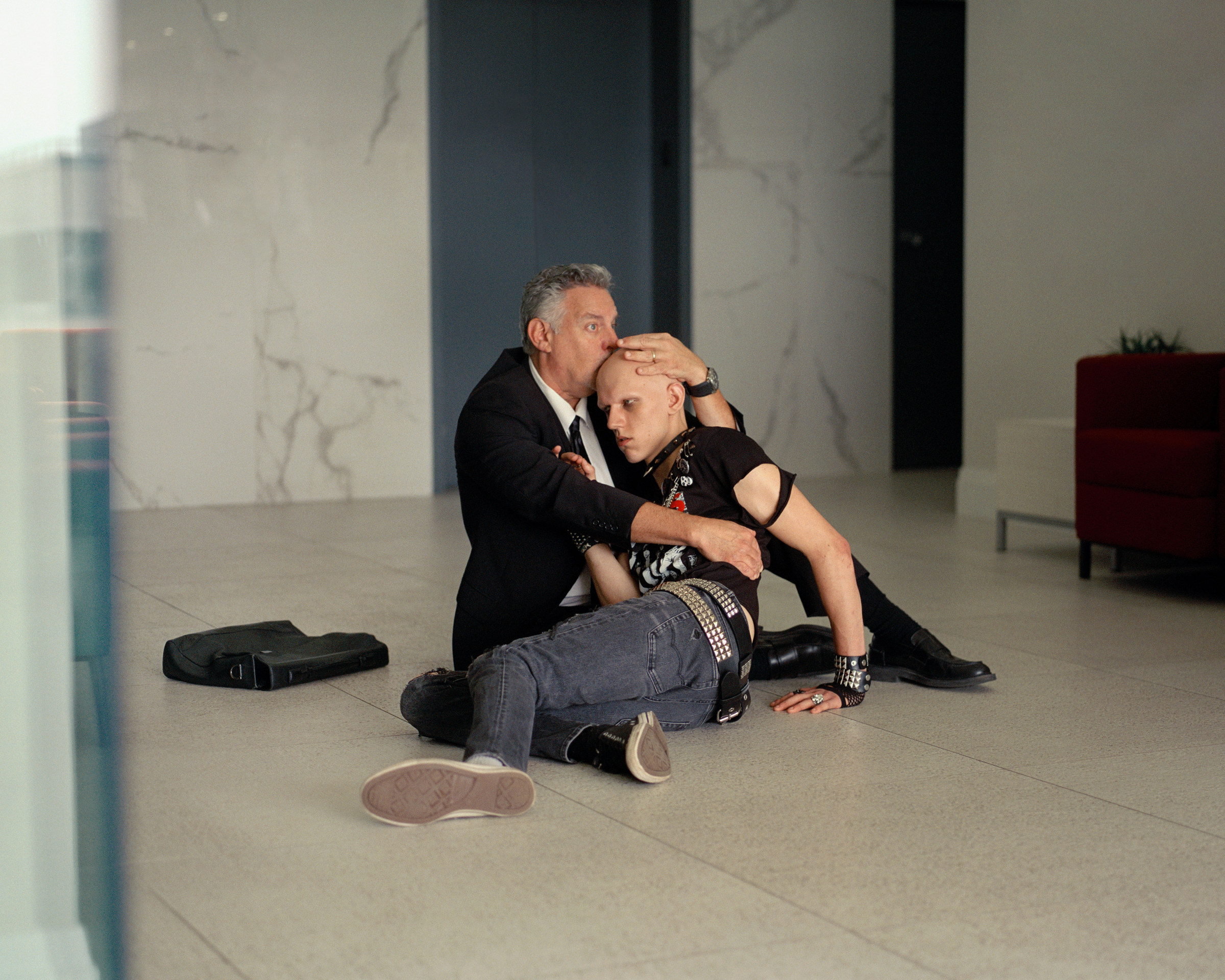
Father and Son: Jake Saint Love Axler, October 14 – November 13, 2026
In 2010, a middle-aged Billie Joe Armstrong, lead singer of the American Punk-rock band Green Day, pulled his pants down and showed a daytime crowd at the O2 Arena his asshole. This act was received with a kind of confused quiet; many people with their children left. At this point in their career—and in mine and my parents’ lives—we were there to see something else, although it wasn’t clear what that was. By the 2010s, the expectation was that this particular strain of Punk had gone extinct: that a more establishment Green Day, a de-Punked Green Day, wouldn’t pull stunts like this, and that children could be brought to see them.
Exposing your ass to previous generations is one kind of Punk gesture. Reconciling with them is another. There’s something about fading out, something about fatherhood, that seems to be a part of the Punk cycle. Maybe part of Punk’s masochism is that it succumbs to the very power it rebels against; it’s so serious about subversion that it’s willing to go all the way and become the establishment. Scott Favor performs this act of submission with a strange dignity when he takes up his father’s business in My Own Private Idaho. The Ramones sold more t-shirts than records, with the shirt becoming more famous than the band. These characters—the fake brothers, the drifter turned businessman—are killed in their father’s arms.
What does it mean for a Punk son to come back to his father? Or more broadly, for sons to reconcile with their fathers at all? Is it a birth, a death, or a killing—and if a killing, who kills whom? Ilya Repin’s Ivan the Terrible and His Son Ivan supports this ambiguity; Ivan bears the wound and Ivan the Terrible bears the reaction. The title, conceived by Repin himself, resolves nothing about who has actually done what. In Saint Love Axler’s image, birth and death seem to collapse into a single gesture. The son’s rebellion can be understood as a death of his father’s image of him, while conjunctly being the birth of an identity of his own. At the centre of this piece is the father and son’s relationship; and the strange and unexpected ways that we are close, yet distant from our fathers. Sometimes we inherit the ways we rebel, and we reconcile relationships in ways that are lonely and involve no one else.
Text by Jimmy Lux Fox