Pivot: Gretchen Lawrence & Margaret Tashkova, March 12 - April 19, 2026
Construction Without Permanent Attachment (Desire)
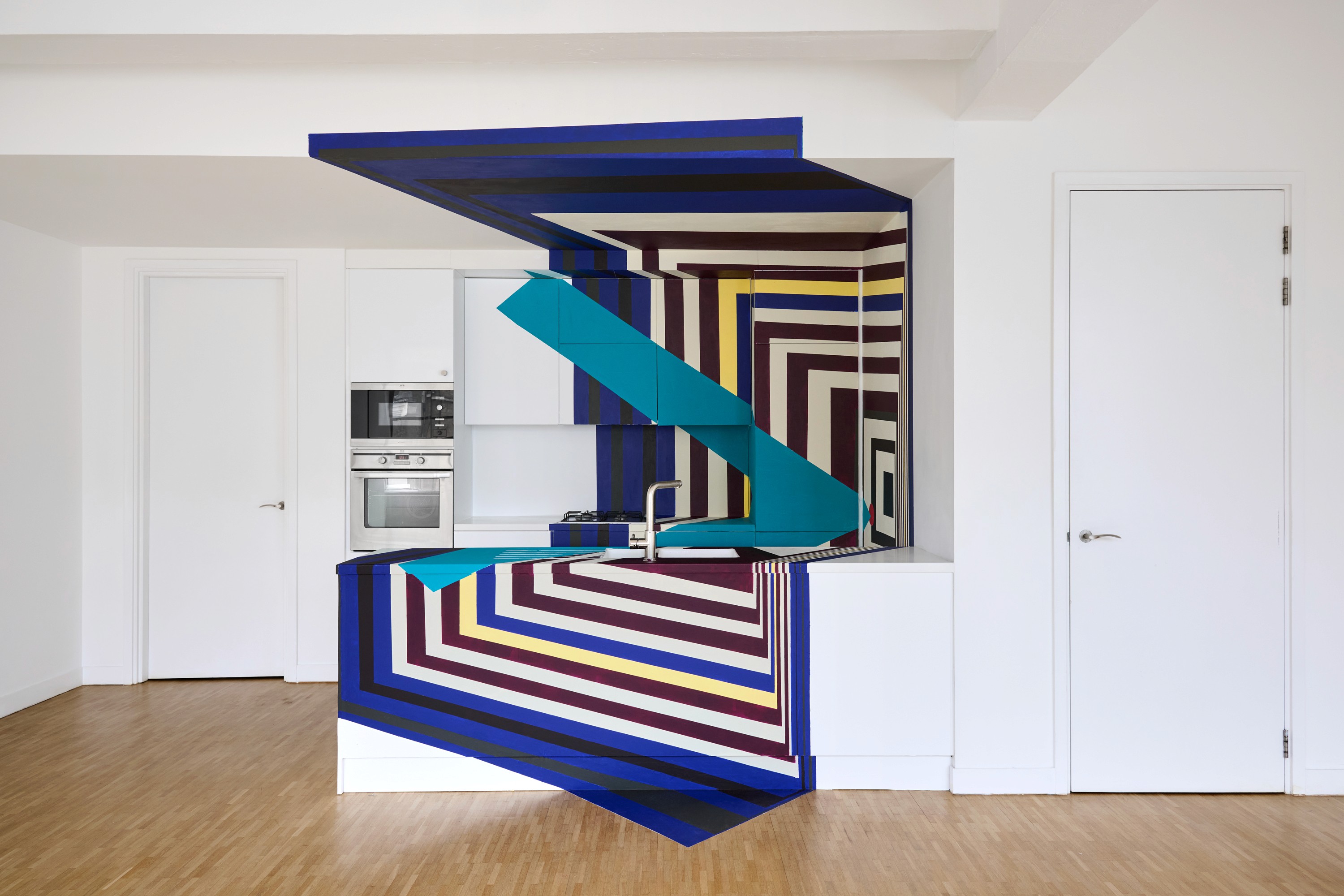
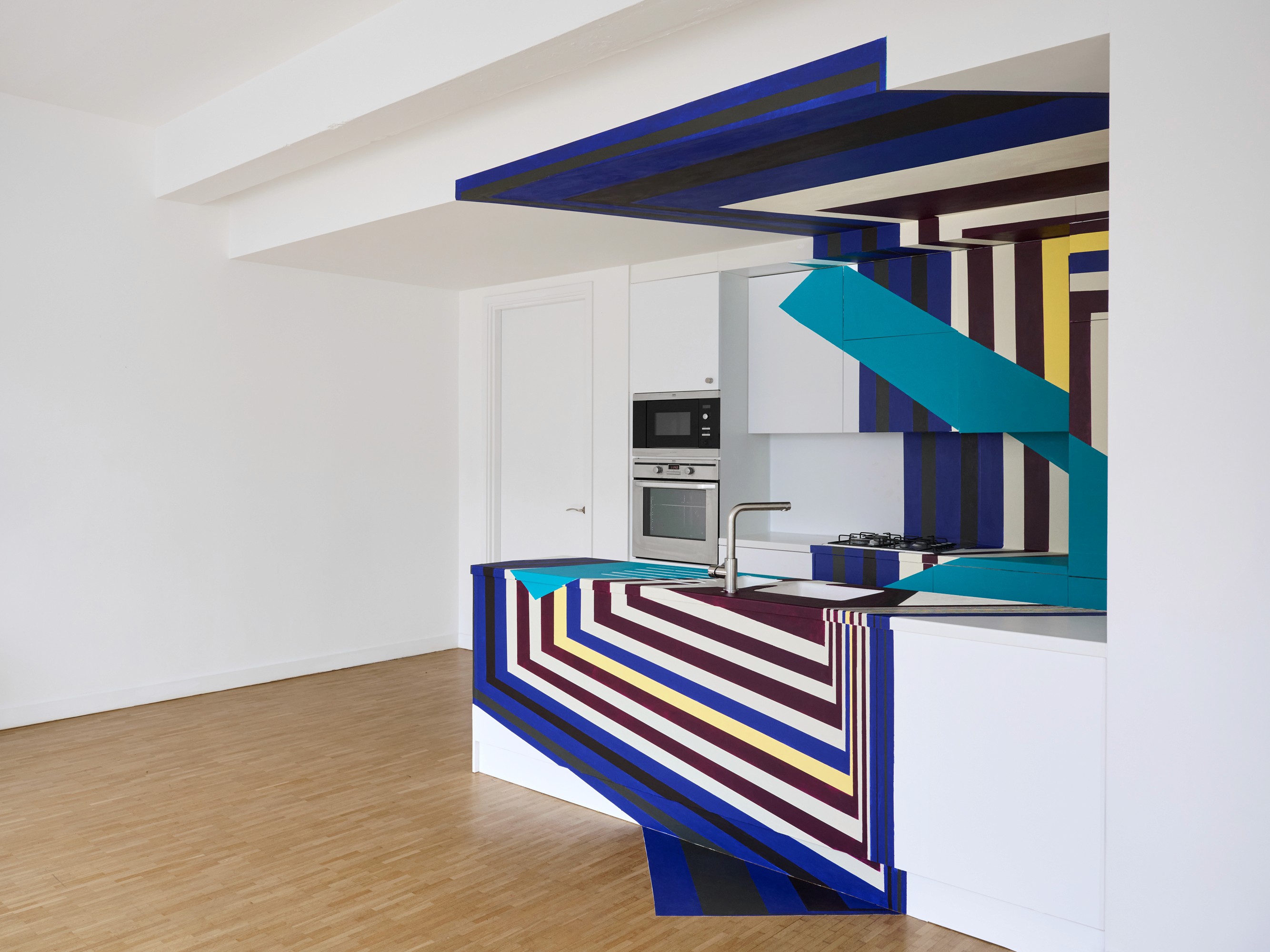
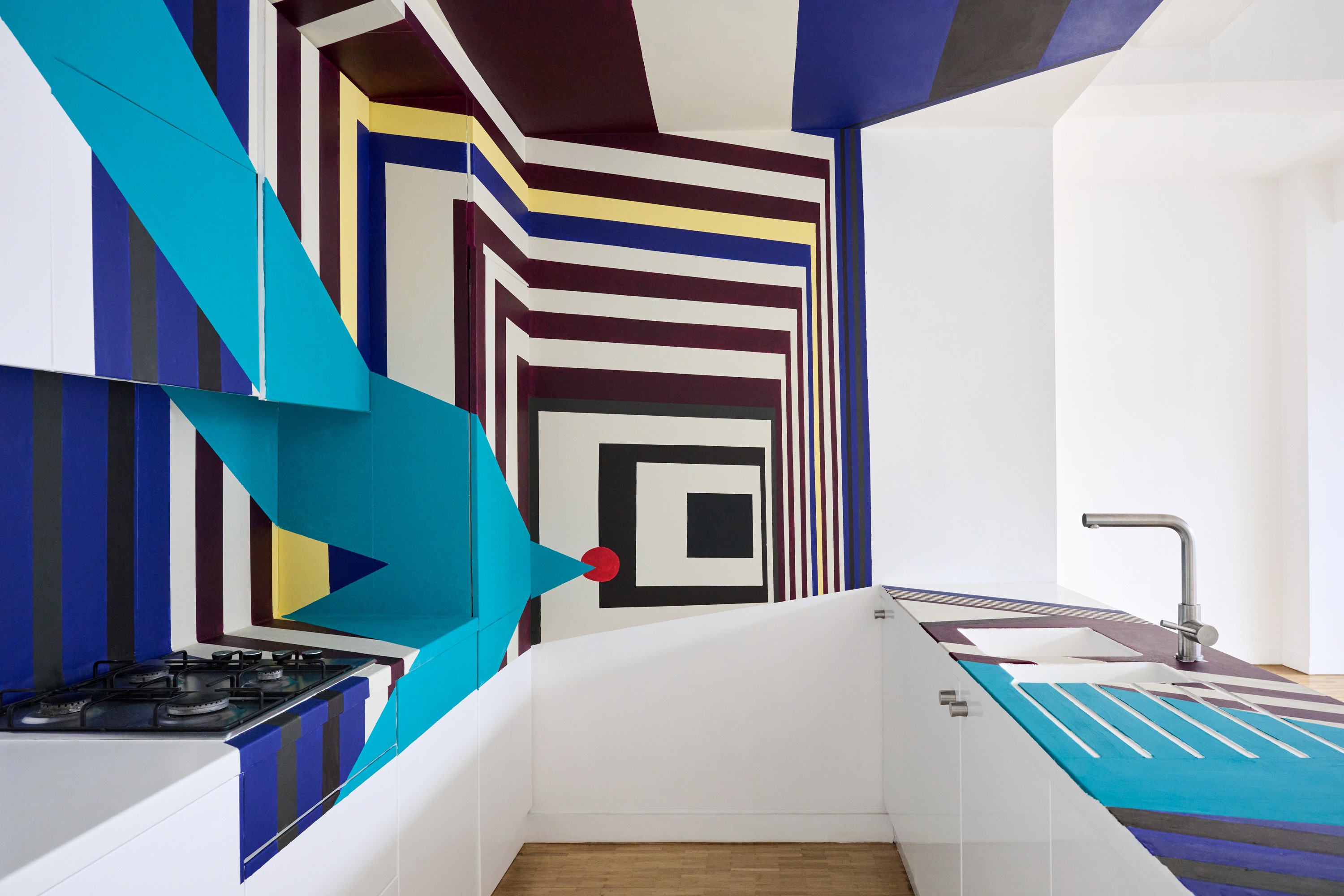
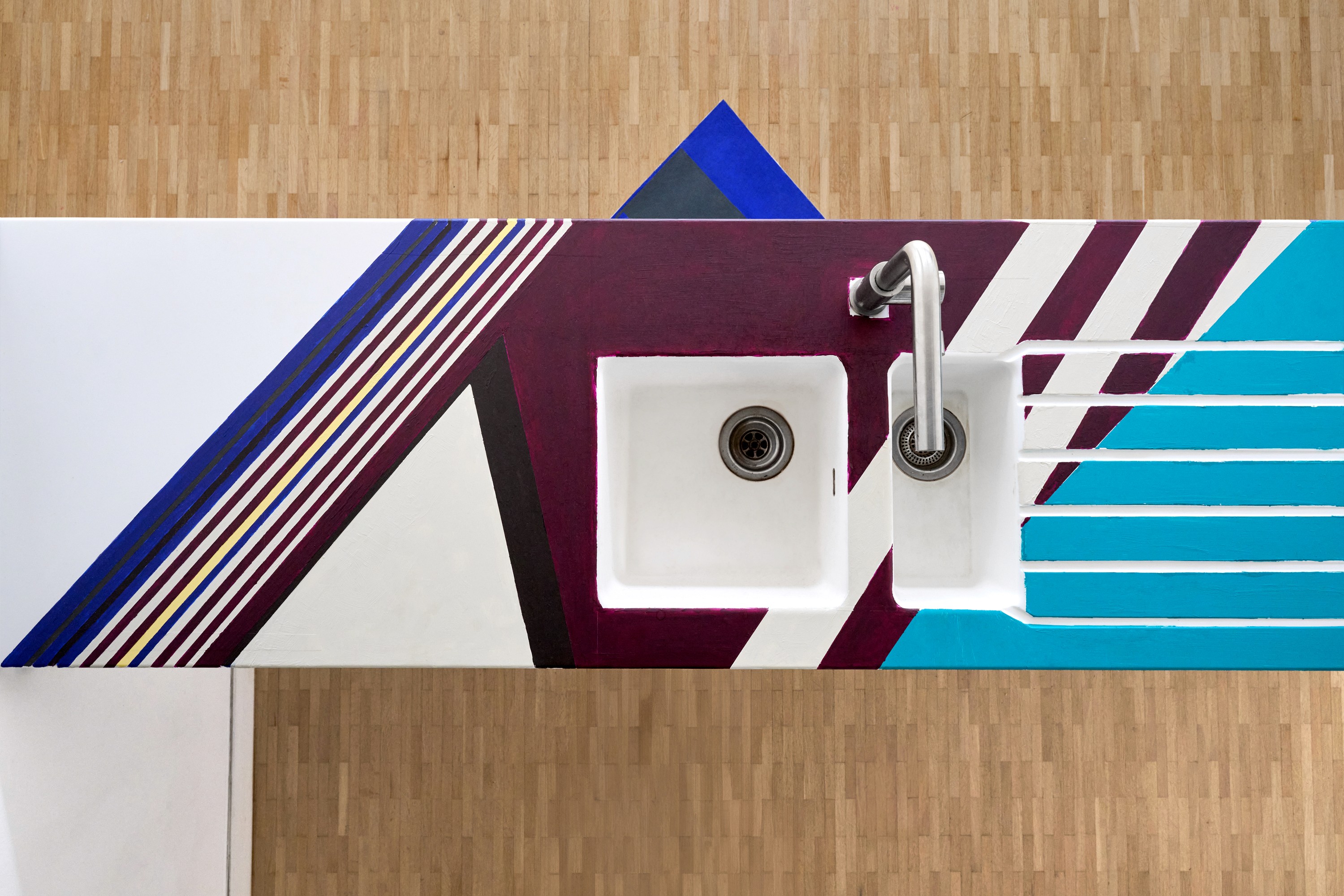
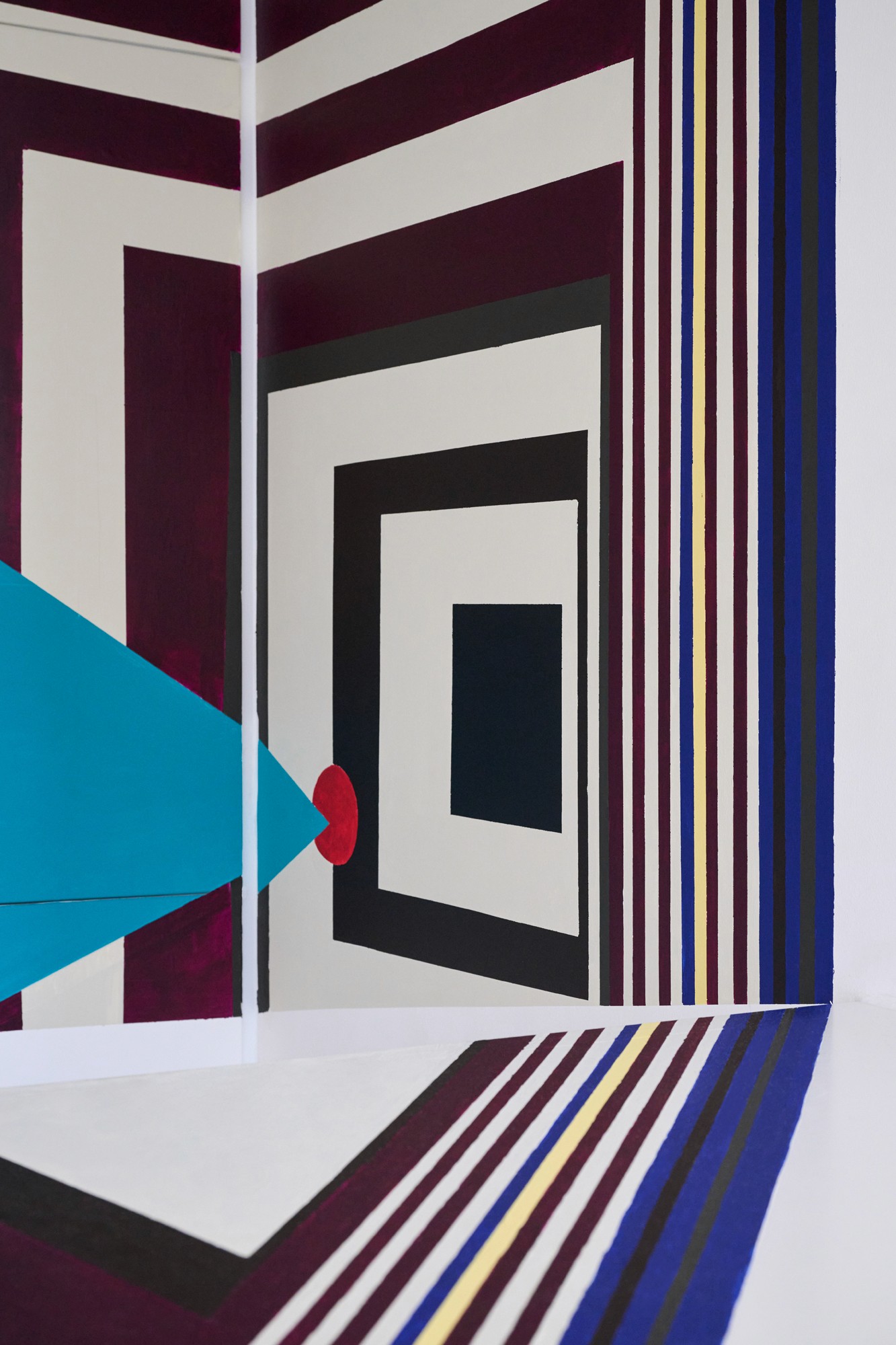
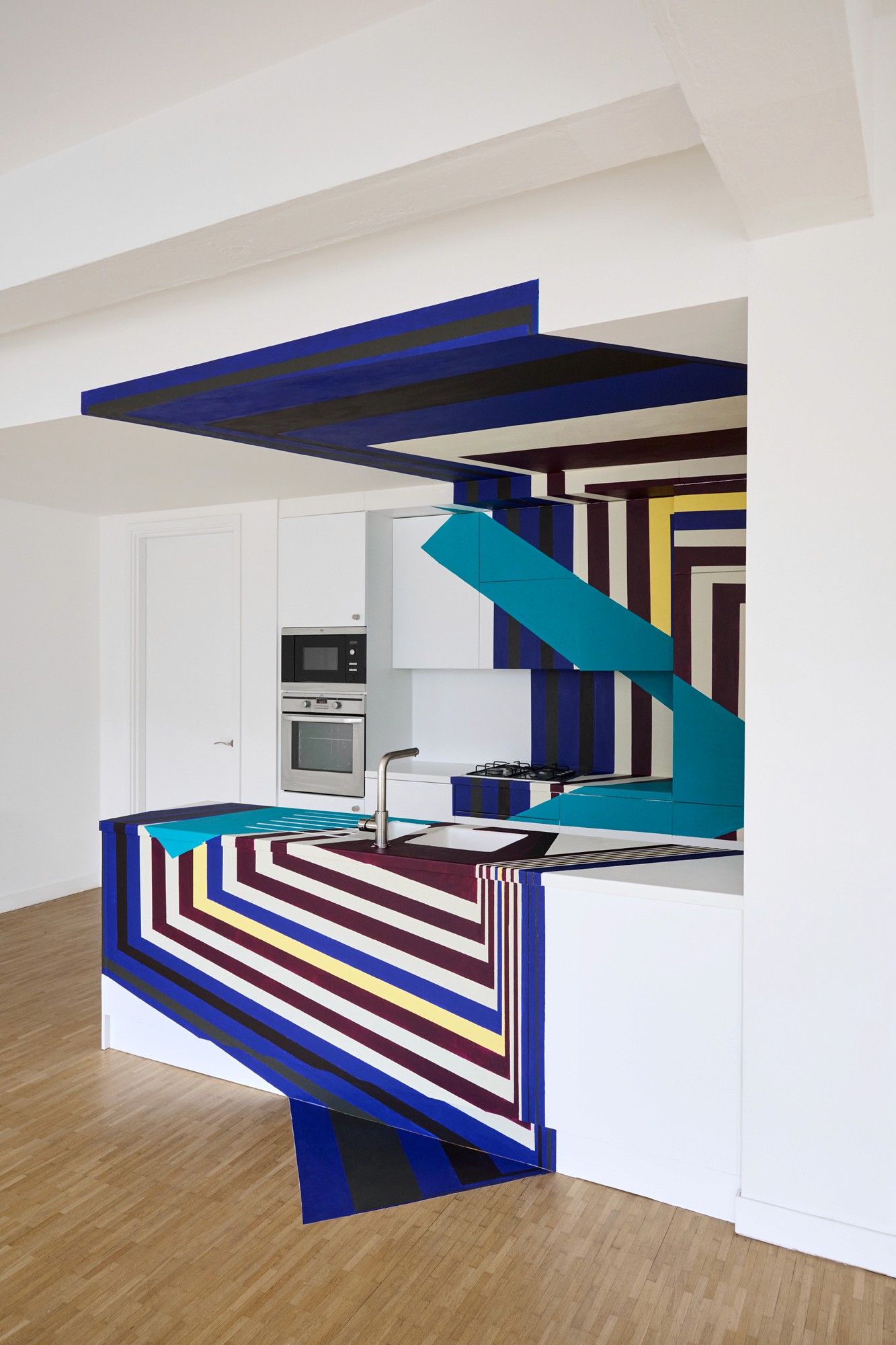
is an abstraction representing anarchic thought put into a consumable and legible form and temporarily installed in the kitchen of a private apartment. Soviet Constructivists proposed that art could be a science, not in the sense of being cold or mechanical, but in the sense of being rigorous, purposeful, and repeatable. They believed that form could be studied, that its effects on a viewer could be understood and deliberately reproduced. They created a visual language that was recognisable, structured and ideological, but not illustrative.This work borrows the formal vocabulary of Constructivism and Op art while remaining answerable to personal experience. The compression of form seeking release, modelled on the logic of natural force, drives the work outward from its own interior pressure. Meaning is not located in ideology or pure sensation but in the nature of desire itself: structurally unstable, non-hierarchical, and resistant to any fixed point of resolution.The three-dimensional surface of the construction aims towards the idea of the realisation of space as a material in itself, treating the architecture of the kitchen not as a series of boundaries, but as a single continuity, from vertical to horizontal without interruption. From a single point in the room the abstraction resolves into a complete image – it reveals itself as anamorphic, withholding its full logic until the body finds the exact position from which everything aligns.The neoliberal kitchen, a space of routine and functional obligation, is temporarily disrupted and will be returned to its white state. The work’s temporality is a precise gesture: desire, by nature, does not hold permanently and doesn’t claim ownership.
Construction Without Permanent Attachment (Desire)
is an abstraction representing anarchic thought put into a consumable and legible form and temporarily installed in the kitchen of a private apartment. Soviet Constructivists proposed that art could be a science, not in the sense of being cold or mechanical, but in the sense of being rigorous, purposeful, and repeatable. They believed that form could be studied, that its effects on a viewer could be understood and deliberately reproduced. They created a visual language that was recognisable, structured and ideological, but not illustrative.This work borrows the formal vocabulary of Constructivism and Op art while remaining answerable to personal experience. The compression of form seeking release, modelled on the logic of natural force, drives the work outward from its own interior pressure. Meaning is not located in ideology or pure sensation but in the nature of desire itself: structurally unstable, non-hierarchical, and resistant to any fixed point of resolution.The three-dimensional surface of the construction aims towards the idea of the realisation of space as a material in itself, treating the architecture of the kitchen not as a series of boundaries, but as a single continuity, from vertical to horizontal without interruption. From a single point in the room the abstraction resolves into a complete image – it reveals itself as anamorphic, withholding its full logic until the body finds the exact position from which everything aligns.The neoliberal kitchen, a space of routine and functional obligation, is temporarily disrupted and will be returned to its white state. The work’s temporality is a precise gesture: desire, by nature, does not hold permanently and doesn’t claim ownership.
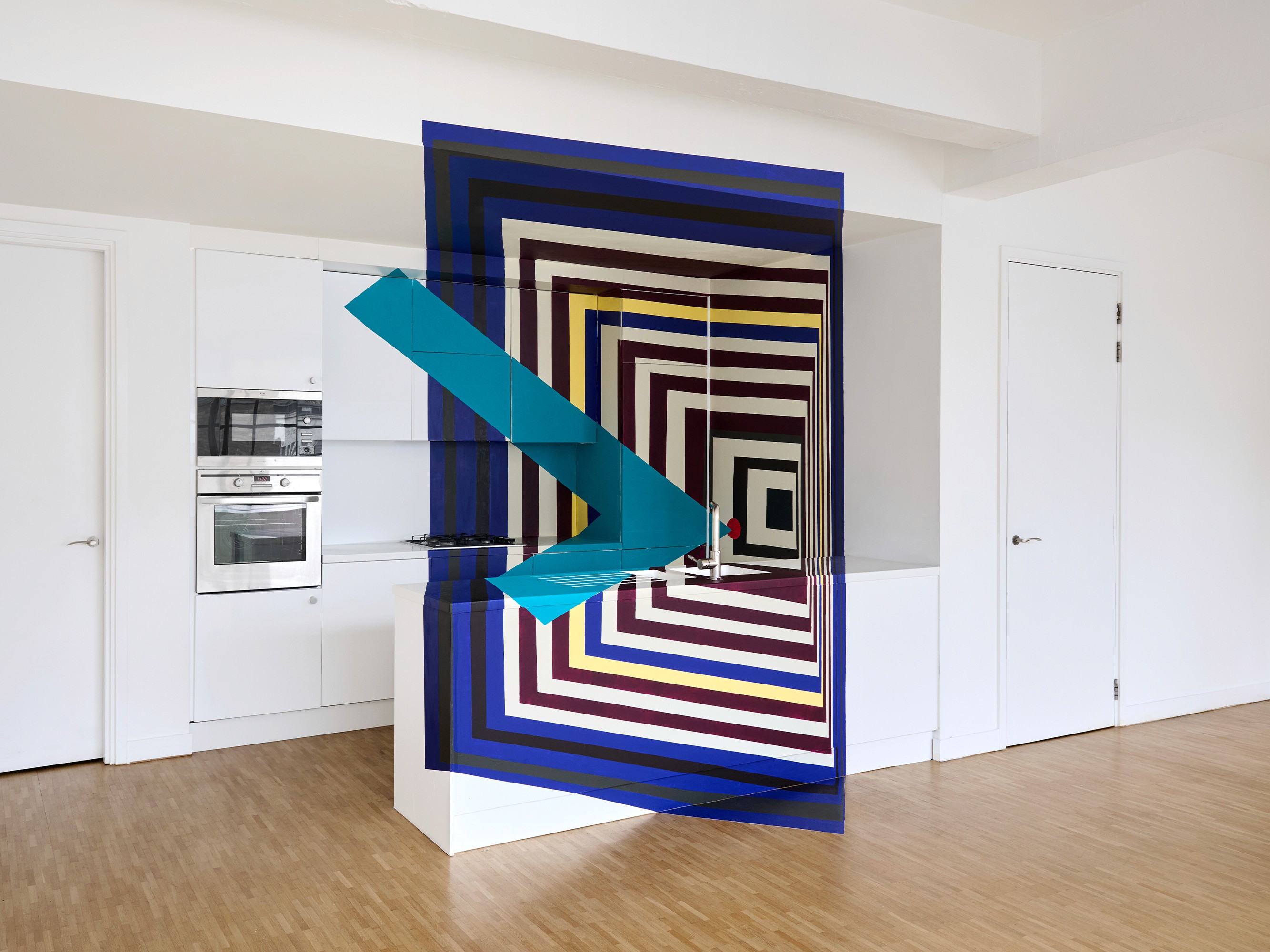
Gretchen Lawrence & Margaret Tashkova, Construction without Permanent Attachment (Desire), water-based paint on vinyl and wall, dimensions variable
Gretchen Lawrence & Margaret Tashkova, Construction without Permanent Attachment (Desire), water-based paint on vinyl and wall, dimensions variable